

To answer the question of “how do you define yourself?” I published this post. By the time we reached the end, I still couldn’t produce an answer. And for the better part of the past 2 years, I’ve had a follow-up post swirling around in my head. While I haven’t fully fleshed out what I want to say on the topic of identity, I’ve started to develop a mental model that I use to frame my ideas around. That’s what I’ll share today. What I hope is that by the end of this, some vague definition will begin to take form.
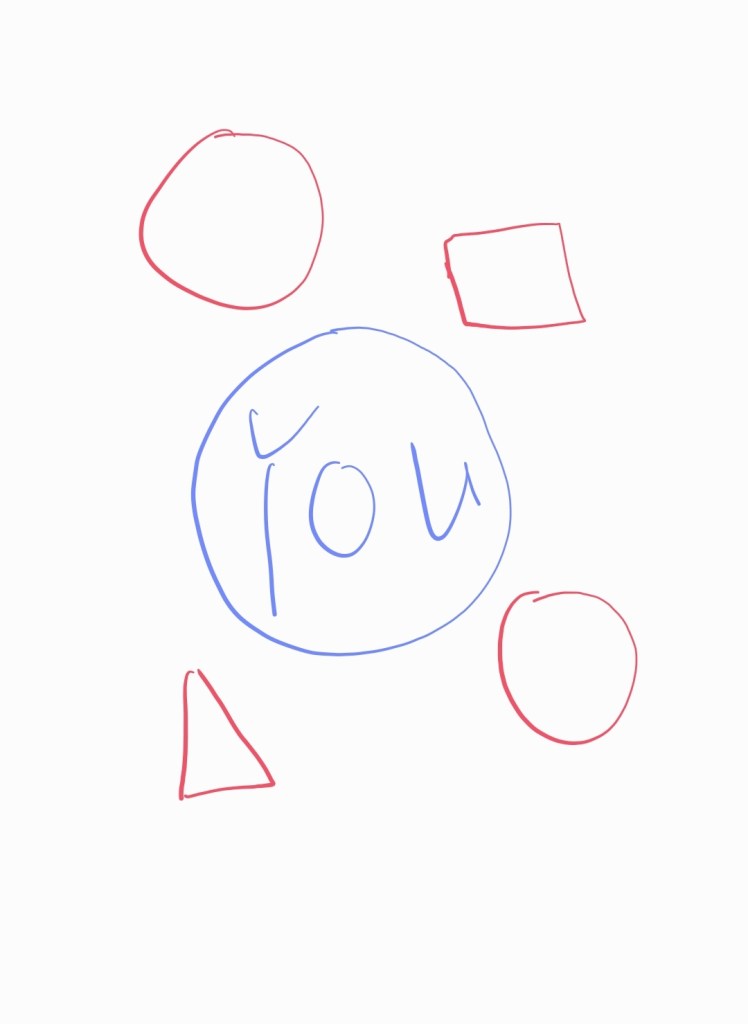
Let’s consider a circle at the center of a blank canvas. The circle represents all that is internal – your experiences, memories, likes, dislikes, etc.

Now imagine various shapes surrounding that circle. These are significant concepts in your life such as family, friends, occupation, and external representations of your interests. Note that they are smaller than the central circle. We’ll come back to that later.
Finally, we’ll add bits of noise around the exterior. This represents everything along the fringes of your life. The trip to the grocery store, the news broadcast you caught a glimpse of at the coffee shop. Stuff like that.
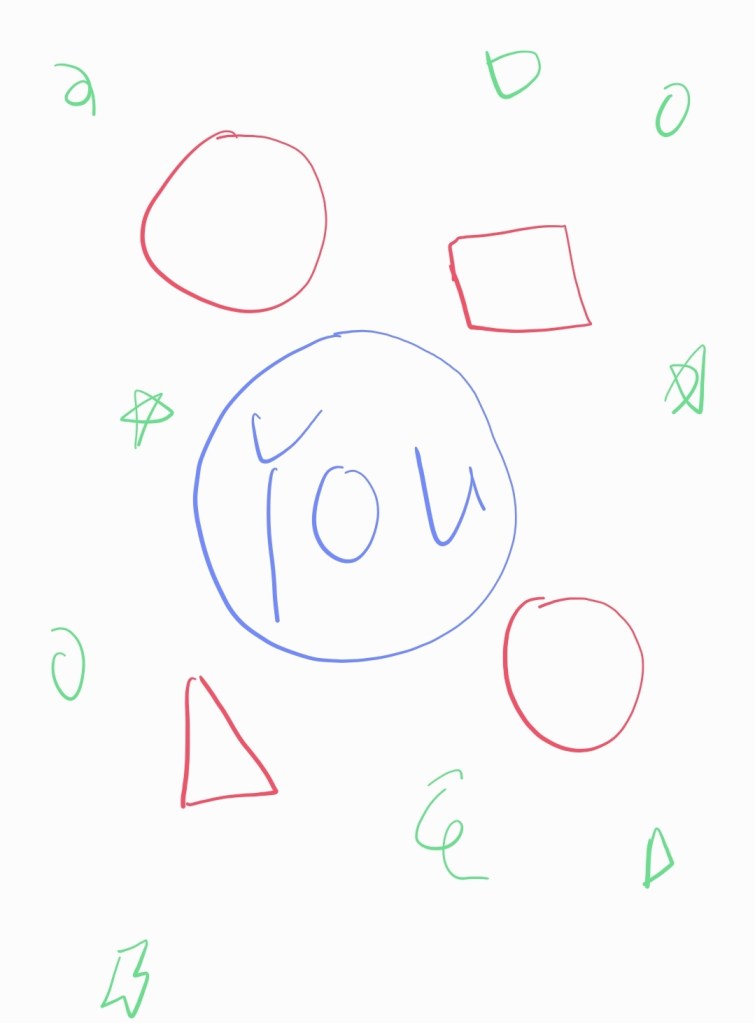
Because I like attaching numbers to things, here’s what I’m thinking – the inner circle (you, in blue) makes up about 60% of what we define as ‘identity’. We like to identify with our experiences and interests after all. The red, about 30%. The people around us can significantly influence who we grow to become. Most music I listen to was recommended to me, for example.
Lastly, I put everything else as the last 10% of what makes up our identities. It’s tough to definitively describe the impact of this category. On one hand, the pleasantries you exchanged with that stranger probably won’t significantly impact your identity as an individual. But then again, small unexpected occurrences can go on to change the entire trajectory of our lives. So I choose to look at it like this – small things that stay small remain in the green category. Anything else will go on to grow bigger and join the red or blue category accordingly.
I find this model of identity helpful in understanding and categorizing all the stuff that goes on in our lives and how they contribute to our sense of self. But it also helps in understanding how identity is initially formed. If your memory was totally wiped, the blue ‘you’ circle would be rather small. Only growing in size due to the influence of all the external stuff around you. Which raises an interesting question – is any part of our identity truly ours? This idea isn’t new, but Fatimah Aliyah discusses it wonderfully.
I plan to explore that final train of thought more in my next (and hopefully last) post on this topic.
 Scripted Journal
2 thoughts on “identity part 1.5”